Sunday, September 23, 2012

Spring Restaurant Brisbane: Review

Spring: 26 Felix Street, Brisbane QLD 4000

While on the topic of all things Spring, I thought I'd share with you my experience at a restaurant named just that.

When Spring first opened a few years ago, I was very excited, because it's selling point is a menu that reflects seasonal, local produce. They also have a 'Chef's Table' dining option, which is where a small group of diners get to sit in a private room, with some of the restaurant's chefs cooking several courses at their table and talking them through the dishes. To further appeal to foodies, the restaurant also offers cooking classes at night. These actually look pretty interesting, especially the 'Nose to Tail Butchery' class, which is not something you see often at a cooking school! I'll probably have to go to one of these ones to get over my slight fear of cooking with big cuts of meat. You can check out their current available classes at http://www.spring.com.au/cooking-school.html.

I was quite keen to have lunch there a few weeks ago with my sister, but, unfortunately, the experience I was to have there was not as wonderful as I had highly anticipated. Let's go in... 


A very bright and modern-looking establishment
The restaurant:

It took a bit a walking from the city centre to find the restaurant, as it is located on the relatively quieter streets of the CBD, closer to the business buildings. On first impression, the place looked fresh and contemporary, and the bright lighting inside made it seem very cheerful and inviting. Upon entering, I could immediately hear the loud buzz of chatter and laughter from the dining patrons (do note that there are a few tables out at the front of the restaurant too). The first room appeared to be full, so we were shown to a table against a wall in the second dining room.


The architecture of this establishment seems to have been focused on creating large open spaces. Doing without the usual flat ceiling makes the interior seem more spacious, and having open-ends to the restaurant allows patrons to be close to fresh air no matter which dining room they're seated in. However, unlike the door at the entrance, which can be shut to block out the wind if needed, the other end, which allows natural elements to free-flow through into the restaurant, is an iron-barred gate panel, around which strangely does not appear to be anything to seal it off with. Unfortunately for us, we were led to the seating against the wall, which was in line with this opening; in fact, we were seated at a table right next to it. While it might be nice to have a cool breeze flow through on a warm, summer day, it most certainly is the opposite in Winter (which it still was when I went). Even if not still recovering from a cold/throat infection, like I was, I can't see anyone enjoying the frosty bite of the incoming currents of wind.

An ill-placed decorative gate panel. The glass-walled room pictured is probably where they hold the 'Chef's Table' meals or the cooking classes.
Creepy decoration
Another thing that I didn't like were the decorative moulds of heads dangling randomly from the ceiling. I guess it's supposed to be artistic, in a contemporary way, but I don't find it particularly tasteful. It adds a touch of creepiness to an otherwise clean, chic-looking eatery.


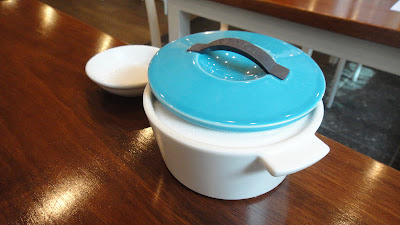
I like how each table had sugar pots in the form of mini casserole dishes, in alternating shades of blue and yellow. It's a bit strange that there's more sugar than salt on the table though.

The food:

I wasn't that hungry on arrival, so I ordered a starter size of the 'Zucchini flowers, grilled calamari, chive and onion risotto', and my sister ordered a main of 'baby snapper with lemon, caper and parsley butter and toasted almonds'. Upon the waiter's suggestion, we also ordered a side of seasonal garden greens to share.

And then came the waiting part.

We waited for at least half an hour from when we placed the order. While this may be acceptable at a proper restaurant, this place functions like a bistro at lunchtime, which means that it should, accordingly, come with the same order-to-food-on-table time frame expected in a bistro. I find this long wait time quite peculiar, since the eatery is based in the CBD, which surely means that the clientele it largely caters for would be the people working in the city, while on their half-hour lunch breaks. I'm usually quite patient when dining out, as it is supposed to be a stress-free, relaxing activity in itself, but it took so long for the food to come out that I almost waved a waiter down to check if they had actually put our order in. While waiting, we checked its reviews on the Urban Spoon website - so, apparently Spring is infamous for its long waiting times. Nice. 

The Bistro lunch menu

My sister's lemon lime and bitter

When the food finally came out, my dish didn't quite look like how I imagined it to, but the presentation was nevertheless clean, and the portion size quite generous for a starter. First up, has anyone noticed the very obvious absence of the zucchini flowers? The main reason I ordered this dish was because I love zucchini flowers, and everywhere I've had it, I've loved it. Part-way through the dish, they finally made an appearance - there were maybe 4 zucchini flower petals dotted over the risotto, under the calamari. Words cannot express my disappointment. Why list zucchini flowers as the first item in the dish description if only parts of a flower are going to be used, and only extremely sparingly as a garnish? Maybe they should have listed parsley in the description, as there was certainly more of that.

The calamari, as you can see in the picture, was burnt in parts and these charred bits tasted so tarry, they were inedible. The popular guideline that one should not order risotto or gnocchi from a menu, as they are usually never made well, also proved to be true in this case. The flavour of the risotto was nice, I'll give them that, but the rice was unmistakably undercooked. The grains of rice literally had hard and chewy centres - a bit like cooked rice, on the dry side, that has turned cold and become even more dried out from sitting out in the open for too long. My sister, who is much less of a picky eater than me, tasted it and agreed that it was undercooked, so I know it's not just me. I would go as far as to say that it's the worst risotto I've ever had, because of that. I couldn't even eat any more than maybe half of it, in fear of facing gastrointestinal consequences afterwards. A pity it was a dud dish, because it looked great on the plate, for a risotto.  

Chive and onion risotto
My sister's dish, on the other hand, was on the other end of the taste spectrum, judging from the little sample I had of it. I love the combination of flavours, and the fish was perfectly cooked. My sister enjoyed it, but said it was a bit too salty. She was right, of course; the butter was a bit overseasoned. The smear of mash was quite tasty, but it's a strange complement to a fish dish. I have a suspicion that they must have confused it with someone's beef cheek dish, which comes with Paris mash, but couldn't be bothered to transfer the fish to a clean plate.  

Snapper with lemon, caper and parsley butter
There's really nothing much to say about the side of greens. It was basically a mix of broccolini and green beans blanched until bright green, but still crunchy, and dressed with oil and salt. I would have much preferred it if they had simply salted the blanching water instead of sprinkling so much salt on top, because it made certain parts of the vegies extremely salty.

Seasonal greens - broccolini and green beans

Overall, judging from this dining experience, I think the menu of this restaurant is a bit of a hit-and-miss. For the price point, which is $25-$35 for a lunch main, this does not meet my expectations. Undercooked risotto, combined with a windy spot on a cold winter's day; an extremely long wait time; and a single unisex toilet cubicle, which had a wet seat and spots of 'liquid' on the floor around the toilet (just thought I'd throw that in), made for a memorable experience....for all the wrong reasons.

Spring on Urbanspoon

Tuesday, September 18, 2012

Jo Malone: Blackberry and Bay

www.jomalone.com
 
I'm a very big fan of Jo Malone fragrances. Before I discovered this fragrance house, I was a mass consumer of mainstream, popular fragrances created by celebrities, and of perfumes by major designer brands, notably Marc Jacobs. I will admit that although initially it was because I loved the smell of Daisy, I ended up buying the EDP, and the 'Eau So Fresh', mainly because of the gorgeous perfume cap designs. Maybe it's because I started to appreciate perfume more, or maybe it's because I grew up, but at some point, I decided to look for a unique fragrance that represents me. And, as you have probably guessed, Jo Malone was the answer I was looking for.
 
Jo Malone creates fragrances designed to be worn alone or layered with others, and as such, it is possible to create your own signature, bespoke scent. The colognes are named after their simple, but gorgeous, blends of core ingredients, and they are categorised under citrus, fruity, floral, light floral, spicy and woody, which makes it easier to find complementary scents to combine. I personally like fruity and light floral fragrances, so my fragrance purchases have included the Nectarine Blossom and Honey and Plum Blossom, their latest limited edition fragrance. So naturally, when I saw the new Blackberry and Bay cologne advertised on the Jo Malone website, I had to check it out. The line was set to be launched officially on the Sunday just gone, so I booked myself in for a complimentary hand and arm massage and introduction of the new fragrance for that afternoon, at the Jo Malone counter at David Jones.  


The hand and arm massage was done with the Blackberry and Bay body creme, which smelt heavenly! I actually like the smell of the cream better than the actual cologne itself, because it's not as strong and you can smell more of the sweet blackberry. Of course, I don't think any pampering hand massage could entice me to buy this product, which costs a whopping $130 for 175mL! The picture above is a bit of a giveaway - I did end up buying a 30mL bottle of this new fragrance. I love the initial fresh burst of blackberry, but unfortunately, this fruity top note doesn't linger long before the heavier, stronger bottom notes take over. I don't know if I'll like wearing this fragrance alone, but I know I will have a lot of wear out of it, when combined with the Nectarine Blossom and Honey that I have. For some reason, layering these two scents somehow eliminates the heavy notes and bring out the scents of the nectarine and blackberry, which I simply adore.


The hand massage was also accompanied by a complimentary little jar of blackberry and bay jam to match the new fragrance. According to the sales assistant, it isn't too sweet and is very yummy, smelling/tasting just like the fragrance. Edible promotional material is just the best, isn't it? Unfortunately, I didn't realise until I got home and uncovered the jar that the safety button on the lid had popped up already. I wasn't game enough to risk my health and try it, so ended up tossing it. A shame really, because it did look like it would be quite tasty.   


I love how the counter offers fragrance samples when you make a purchase. I love the Wild Bluebell cologne alone and when combined with the Blackberry and Bay, so I might have to purchase that next! A lot of skincare counters don't like giving samples, but I think it really is the best marketing strategy you could employ. The sales assistant also gave me little samples of the Blackberry and Bay, and French Lime Blossom body cremes, the latter being because she didn't have a sample of the fragrance, which I really wanted to try together with the Nectarine.


The only thing that prevents me from buying Jo Malone products more often and freely is the price point. I know that products imported into Australia generally get a huge mark-up, for some peculiar reason, especially for fragrances and skincare lines, but I think it is absolutely ridiculous that a 30mL bottle of cologne retails for $90, when it is £38.00 (~AU$59) in the UK, a 100mL bottle is $170 vs £76.00 (~AU$118), and a 175mL of body creme, as mentioned before, is $130 vs £48.00 (~AU$75). Surely, even if taking into account the shipping cost of wholesale product quantities would not justify this? And they wonder why consumers are largely shopping online and/or holding out on purchases until they go on overseas trips. Regardless, I will not give up so easily on Jo Malone products, because it is, at least for now, my mainstay fragrance line.

I encourage everyone else to break out of conformity with trends, and find their own signature scent to express their individuality. No one likes to smell like the dozen other girls in the same office, right? I should also point out also that Jo Malone fragrances are not differentiated by gender; so guys, you can also have some fun with these!

Happy fragrance combining!


Monday, September 17, 2012

Springtime afternoon tea

 
Purple passionfruit
I love passionfruit, because it reminds me so much of Summer. With the warmer weather setting in, I've been buying bags of passionfruit from the farmers' market so that I would have it on hand, should baking inspiration strike. As my next door neighbour (the nice one) is in her recovery phase from a long battle with the flu, I decided the other day, on my day off work, to bake a passionfruit cake and take a slice over to her for afternoon tea, in hope that it would help to lift her spirits a bit.
 
I don't like using artificial colours, flavourings and essences, if I can avoid it, so for this cake, I use the actual juice from fresh passionfruit. I extracted the juice by pressing the pulp of about half a dozen-ish passionfruit through a sieve. The aroma and taste of passionfruit are quite strong, so using the natural fruit juice will sufficiently bring out its flavour in the baked cake. As you can see in the pictures below, the juice is also pigmented enough to stain the batter with a yellow-orange hue.
 

Mmm doesn't this remind you of a lemon meringue dessert? I am convinced that a passionfruit meringue pie would be equally as delicious. Perhaps I should try that next time?


The light, fluffy final batter, after mixing in the cloud of whisked egg whites.
On this occasion, I decided to bake the cake in heart-shaped springform pans. The shape is too pretty to be only taken out for use once a year, on St Valentine's Day.


Cooling the cake layers
I usually prefer my cakes layered and sandwiched with a filling, fully-frosted and prettied up; however, because I wanted this cake to be light and Springtime-y, and for the passionfruit flavour and colour of the cake to take centre-stage, I made it a more casual affair by simply topping a single cake layer with whipped chantilly cream, spooning over some fresh passionfruit pulp, to hint at what to expect, and finishing off with a sprinkle of toasted flaked almonds, to add that extra crunch factor. (If you've been following my foodie posts, I think by now you would know that the textural elements of a dish are very important to me.)
 
Ta-da! A rustic, homely afternoon tea cake. 
The colour of the juice baked into the cake (as you can see below) and the cake layers not only smelt of passionfruit, but you could also taste the citrus-y tang from it. Natural is best and it works!


Eating this cake took me back to the (too) brief two weeks I spent frolicking under the Hawai'ian sun two Springs ago. Just a bit of trivia for you, the passionfruit is called the liliko'i over there and was introduced into the Hawai'ian islands by a man named Mr. E. N. Reasoner, who brought the seeds over from Australia. The fruit is now available in abundance on the islands, and is a popular flavour for various desserts, ice-cream and sauces.

Oh, and I didn't end up bringing any cake over to my neighbour, because she headed out before the cake was done. Turns out that even people who are unwell have more of an active social life than I do!
 

Tuesday, September 11, 2012

Pests, macarons and knitting.

Crows. Ugh. That pretty much sums up what I think of them.
 
Unfortunately, the couple who live in the units two blocks down don't share the same sentiments. Through our mutual neighbour, I found out that they feed the birds - crows, ibises, bush turkeys, you name it - not just birdseeds, but actual MEAT and other kinds of substantial food. Why wonder the crows in the area are so large and fat! You could imagine the sort of problem that ensued, following this unnatural feeding activity. My backyard, and those of my adjacent neighbours, used to be visited by rainbow lorikeets, kookaburras and other pretty birds, but all of these have since been scared away for good by the murder of crows that have seemingly taken permanent residence on the large tree in my neighbour's backyard. Even their collective noun sounds awful!
 
Going off on a slight tangent here, according to an online forum I came across, which revolves around word ancestry, this collective noun for crows finds its origin back in the 15th century. There are many stories out there that seek to explain the choice of wording, most of them from old folklore or superstition; but, for the most part, it's related to their presence in battlefields, cemeteries, roadkill, etc, where they would execute their scavenging activities. Because of this, and I suppose the fact that they have black feathers, a gathering of crows is also considered to be a bad omen. I am not normally superstitious, but I swear that my 2 years of very bad luck started when these scavengers of the sky started to form a clan out the back.
 
Back on track, these awful pests are dislikable in more ways than just their mere ugly, bad luck-suggesting presence. From morning till dusk, all you can hear is their incessant cawing and squawking. One can no longer sleep in, because the crows also like to sit atop the eaves of the rooftop cawing, and making thudding, tinny sounds on the metal-based eaves. We also have a satellite dish out the back, which now, thanks to the pesky crows, has a dislodged cap. Most annoying of all is the fact that now I have to inspect every inch of every side of a garment I hang out on the clothes line, because, more often than not, there would be at least one item of clothing - usually belonging to me, and usually one of the more expensive pieces - stained by bird poo. Remember how I mentioned that the birds are very large in size? Well, their droppings are accordingly XXL too. It was the last straw when I noticed that they were starting to pick on the daffodil sprouts that I had planted around little Teddy's (my late pet) plot (only about 6-7 of the bulbs of the 10 survived the repeated attempts of the bush turkeys to dig them all out).
 
Since, for some very odd reason that is totally beyond me, crows are federally protected birds, I hopped on the www to do some research on legal pest control options. All factors considered, I decided on a fake owl with reflective eyes and a pivoting head, which I saw listed on ebay.
 

Teddy's guardian owl
Ideally, I would like to mount the owl onto a fence or somewhere in clear view of the birds, so that they would know to back off from afar. As this was not possible, the owl ended up being placed directly next to Teddy's plot, so that this area at least was hopefully not going to be disturbed. Was this strategy effective, you ask? Well, on the days when I am at home, there does seem to be fewer birds in my backyard, and even when there are birds, they seemingly try to keep their distance from the plot. I don't know how long this is going to last for though, because, since it's made of plastic, the owl gets blown over by the wind some times, and due to it's placement on the ground, the head of the owl can't use the breeze to pivot around and look active, and the light doesn't catch the eyes to make them look reflective and real. Crows are, unfortunately for us, quite smart creatures, so I am worried that, sooner or later, they will catch on.

Yep, a lot of weeding needs to be done soon!
Two weeks ago, when I went to the West End markets, I bought one each of chives and dill in a pot. I've always wanted to grow my own herbs, because I love using them and want to have a variety of them at my disposal. However, I've never gone through with this, because I know that my pet dog (at the time) would more likely than not knock them all over or nibble at them. I decided to start off with these two herbs and see how they fare, before I invest in more. I placed them at the top of the back steps, where they would still have some sunlight, but would be away from where the birds normally swoop around.  


But the very next afternoon, this is the site I was greeted with:
 

The crime scene

My beautiful pot of dill unpotted and shrivelled :( The pot itself was found further down near the fence.
Clearly, placing the pots closer to the house was not going to keep the birds away. They even broke the magnolia egg plant that my sister bought me for Christmas (see top of stairs)! I managed to salvage the chive plant and repotted it; however, the same thing happened the next day, and this time the plant was too damaged to survive. Either the crows were trying to search for worms in the potting, or they were just being a menace. Either way, that is sadly the end of my herb-growing venture for now.

On to brighter matters, I also visited the Delice stand that day at the farmers markets to buy some macarons. I was very happy to discover that they had introduced a new flavour - macadamia!


Macarons! Macadamia (brown), pistachio (green) and bubblegum (blue).
 
It has a more toasted, nutty flavour than the pistachio, and is just scrumptious! It's my new favourite flavour for sure! The tops of the macadamia macarons are also dusted with edible gold powder, which makes them all the more alluring. You can read more about these macarons in my other blog post, Regional Flavours 2012. 
 
 
The shimmery gold tops

I've been trying to pick up my knitting needles more lately, since the change of season calls for new garments to be made. Okay, so you will notice that below is something I've started knitting ages ago... but I'm making progress!

Knot-sleeve blouse slowly taking shape
 
I've done the waist shaping and am now up to the bust shaping section. I was initially a bit worried about the size of this garment. I cast on for the smallest size, just because the next size up seemed like it would be too big for me, and, being a fitted blouse, I was worried that it would hang loosely on me and look dreadful. The smaller size measurements, however, are smaller than my body measurements. I hoped that by knitting at a more relaxed, but even, gauge, I would be able to somehow achieve the right size. After knitting the twisted rib section, I was struck with the idea of measuring it against one of my fitted Alannah Hill cardigans (yep, I'm a cardigan girl), and was relieved to find that they were about the same length across, unstretched. Hopefully the increases in the bust shaping section is enough to offset the preceding rows of decreases, and allow for a good fit.
 
Meanwhile, I'm loving the yarn (Blue Sky Alpaca Royal); it is an absolute joy to work with. The fibre is luxuriously soft, and I have not, thus far, had any problems with it at all. It's also quite light, so even though I am knitting the garment seamlessly on circular needles, the weight isn't burdensome on my hands. I am also realising the benefits of working with yarn that comes in skeins as opposed to balls. Even though it may be a bit annoying and time-consuming at first, having to wind the skeins into balls before use, it allows me to knit confidently, without having to worry about finding random knots mid-row.
 

I love that the twisted rib panel sits nice and flat!
I know I said that I would try to practise project monogamy, but I wanted to knit a Summer-compatible Great Gatsby Dress in time for the warmer season. I decided to knit this with Belle Organic DK by Amy Butler for Rowan. This is a blend of organic cotton and organic wool, which forms a smooth and light yarn. Knitted up, it creates crisp stitch definition, which also somewhat helps to open up the lacework. I do notice, however, that the zigzag tips don't lie completely flat, possibly because, unlike the RYC Silk Wool DK, it is not weighty enough to keep the stitches down. It is also because of this relative lightness, though, that ensures me the completed dress won't be pulled down by its own weight.


Clean stitch definition
 
Speaking of knitting, I better head off to do more of just that! Adieu!


Sunday, August 26, 2012

Did someone say duck?

I love duck, especially roasted duck, so naturally, after mentioning duck congee in my previous post,
Being sick: Medicines and food, it was all I could think about. So yesterday, when my dad wanted to buy some crispy Chinese roast pork belly from a Chinese butchery/barbequed meat shop for dinner, we decided to buy half a roast duck as well. The butcher usually chops up the meat for you as well with a meat cleaver, so it saves you getting your kitchen dirty at home, doing it yourself.

 
Roast pork belly and roast duck - the two tastiest things from a Chinese BBQ shop!
 
As tempting as it was to just attack the delicious, golden-skinned juicy duck with my bare hands, dripping copious amounts of liquidised fat and marinade over a bowl of jasmine white rice, I had to remind myself that I shouldn't be eating roasted meats and such, while I was still inflicted with a bacterial throat infection and nasty cough. That's right: the roast duck was bought exclusively to flavour my congee. When I make duck congee, it's usually from left-over duck from dinner (same goes for the chicken for its version), so this was going to be one luxury congee.
 
Okay, so I know that most people think that congee is nothing to get excited over, and might think that it's silly to devote a blog post to it. However, when I cook something, I like to know a bit about it, and I'd like to think there are people out there who are the same. Cooking and eating, to me, is not just a culinary experience, but also an educational one, because through food, we can get an insight into different cultures, their lifestyle, their diet, their history even. It's so unreal to think that we're able to eat the same food via the same cooking methods as the people who lived many, many years, possibly even hundreds of years, before us did. Moreover, cooking food from other cultures, together with this learning, somewhat connects people, without even needing to know the language, and allows them to recognise in each other, not a foreigner who has different values and beliefs, but a fellow human who also frets about the prospects of their crème pâtissière curdling over too-high-a-heat. Surely I am not the only one who finds this food connection fascinating?
 
So what exactly is congee? Congee is basically like a rice porridge, which is commonly eaten in many Asian countries, such as China, Taiwan, Korea, Japan, and Indonesia, where rice is the staple in their diet, as well as in Portugal. In the old days, congee was mainly eaten by poor peasants, who could not afford meals of rice, and accordingly, it was the mainstay meal during famines to stretch the rice supply. Additionally, it was also the main form of sustenance provided for the sick, usually made with a thinner consistency and left bland, because it is easy to swallow and digest, while still providing semi-solid food to fill the stomach and satiate hunger. Nowadays, rice congee, like most other originally peasant foods of other countries, such as Italy's ciabatta, is eaten by all, regardless of societal status. As such, it can be found on the menu at many Asian (though predominantly Chinese) restaurants and cafés here in Australia. The time the dish is eaten; the type of rice and grains used to make the congee; the other ingredients added to it; and its consistency differs according to culture and geographical location, but common to all congee-eating countries is the fact that it is still the choice food during illnesses. The version I make is the Cantonese congee.
 
I'm sure most people out there would be familiar with how to make rice congee, as it is Chinese cooking 101, but I thought I'd post up some pictures anyway, for those who don't (and if that is the case, refer to the link provided above), and explain the process a little bit.
 

Cooking congee (and yes, while drinking pearl milk tea from Sakuraya - it does gets boring) 
I think of the cooking process of congee as a bit like that of the Italian risotto, in that the rice is slowly cooked in liquid, releasing starch from the grains to slightly thicken it. Of course, the end products are totally different, congee being less substantial and 'lighter' both in terms of texture and calories. Well, that is, unless you add a lot of whole duck meat; that's a different story. Risotto is also easier to get wrong (in fact, I had a bad risotto experience at a bistro just the other day - story to come in a later post) and involves more steps. However, both require you stand over the pot, stirring constantly for the whole cooking time, and both take around the same time to prepare. At this point, I should mention that congee usually takes a bit more than an hour to cook, not the half-hour I guesstimated in the other post - oops, sorry! I timed it this time.

I know that a lot of people can't be bothered to constantly stir the congee, and opt to just lower the heat, pop the lid on, and let it cook by itself; but this extra attention is important, because you want to cook the rice over high heat with a rolling boil, and if you don't stir, the water will just boil over the sides and possibly extinguish the gas flame, potentially causing a gas-leaking hazard (yep, that's what happened that other night when I was distracted by blogging). You want the heat to be high, so that the rice disintegrates quickly while continuing to cook, and by constantly stirring, you're coaxing the starch from the grains into the cooking water, to thicken it and achieve an overall soupy consistency. So you can imagine that if you leave the pot on low heat, the bulk of the water will evaporate before the rice breaks down sufficiently, and you will end up with a nubbly gruel, where the grains are still distinct from the watery liquid. Some people don't mind this, but the way I see it, why bear with something that doesn't taste nice, when you know you could make it better with just that little bit more patience?

Basically, you want it to go from this.....

At about 15 minutes: the rice is partially cooked


.....to this...
The duck meat was added when the rice had reached its water-absorbing capacity and had started to disintegrate

.....and finally to this.

At this point, the rice had almost completely disintegrated and the congee had thickened
You want to make sure you add enough water at the start, because, as you can see from the picture below, you only have a bit over half a pot left by the end of the cooking time.

Enough for around 4 serves
 
For the congee last night, I had removed the skin and its underlying fatty layer from the pieces of duck before adding to the congee, in my attempt to make a healthy, low-fat, low-sodium, sick people-friendly version (but who am I kidding? Most of the tasty skins ended up in my mouth!). However, under normal circumstances, I would have added the whole lot - bones, skins, fat and all - to the pot, in order to best extract the flavour of the roast duck. Nevertheless, the healthier version still had the flavour of duck, but less intensely so, and, best of all, was without obvious traces of oil - well, except for those left by my roast duck wing! Alas, I couldn't resist afterall.
 

Duck congee at its healthiest


Not bad for a sick person's food!
 

Thursday, August 23, 2012

Knitting into the Spring

I recently started working on my Knot-Sleeve top again, after finishing the band of a beanie I am knitting my sister. I am finally past the bottom border and onto the waist shaping *phew*! There's so many projects on hold at the moment, because they're waiting to be blocked. Besides the beanie, there's the cross-over stays from the Jane Austen Knits magazine, which is otherwise almost all done! I guess it will be ready for Spring/Summer....
 
The problem is that I have limited room in my house, and there is no single room with a big, clean, uncluttered table, on which I could block my work. On top of that, I have a shortage of towels - there is literally just enough available at a time for use in the bathroom; hence, I will need to buy more white towels just for blocking. For smaller items, I've actually been using my ironing board, covered in plastic bags; ridiculous! I saw on the Coco Knits website what the creator calls the 'Knitter's Block Kit', which looks like just the thing to solve my problems (except for the space problem). However, shipping to Australia from the US for these costs almost as much as the product itself, and will altogether set me back almost $100, just for the small kit of 9 tiles! I think I'll just buy some cheap towels, thank-you very much. For those of you living in the US, and won't have to pay an arm and a leg for delivery, you might be interested in this nifty product: http://store.cocoknits.com/categories/products/knitter%E2%80%99s-block/.
 
I also forgot to post a picture of my completed charity beanies for premmies/sick babies at one of the local hospitals, which I finished a month or so ago. Here you go:
 

I was a bit less creative with the designs this time, because I wanted the beanies to mainly go to the babies in the neonatal ward this time, as opposed to in the hospital foundation's shop. A friend of mine is expecting a baby girl in September, so I can put my creative cap on then!

Wednesday, August 22, 2012

Being sick: medicines and food

It's been a week already, and I'm onto my last dose of antibiotics, but not only has my condition not improved, the symptoms have seemingly gotten worse. It's rather frustrating, especially since I've spent more money on this particular occasion than for previous bouts of similar sore throat/cold/cough conditions. Although this blog is not intended for health advice, I shall list the things I have tried and what they are for, in case some readers are also unfortunate enough to be suffering from the same condition and might find this information useful: -

1. Ventolin puffer/syrup: Salbutamol. Largely used in asthma, but also used in some other respiratory conditions, including bronchitis, for bronchodilation. In my case, the bronchodilation is to help stop the coughing - but it didn't work for me at all. Best to opt for normal over-the-counter cough syrups instead. Ventolin Syrup is available via prescription only. (Note: not routinely recommended for cough relief (use only on medical advice), nor does it replace the need for preventers in asthma, due to the desensitisation of the receptors in your airways that will occur with overuse.)
2. Pholcodine (e.g. Benadryl Dry and Tickly Cough): A cough suppressant for dry, unproductive coughs. The other non-herbal alternative is dextromethorphan (e.g. Robitussen Dry Cough Forte), but if you're taking mood-alterating medications, pholcodine is the safer option for you.
3. Dimetapp Cold and Flu Elixer: Contains brompheniramine and phenylephrine. These 2 ingredients work to decongest your nose and dry up nasal secretions. (Note: should not be used by those taking mood-improving and blood pressure-lowering medication, as well as other medications that also have a sedating or drying effect.)
3. Soluble Aspirin (e.g. Disprin, Aspro-Clear): an anti-inflammatory drug that is commonly recommended by doctors for sore throat conditions. The idea is to gargle the prepared solution, so that some is absorbed locally to help target pain relief at the site. For those with high blood pressure/other heart conditions, I'd spit out the solution after gargling, or, even better, gargle instead with...
4. Warm, salty water: fill a cup with water and dissolve about half a tablespoon of fine salt (or more, depending on the amount of water). Gargle a few mouthfuls at a time, for as long as you can each time. I usually opt for this, but was so desperate that I tried the aspirin. The result? It's really gross, and doesn't work (but I'll admit I gave up after one go). Back to the good old salty water.
5. Difflam cough lozenges: has antibacterial and antiinflammatory properties. Flavours sound nice, but tastes gross and has a numbing effect, even though I bought the ones without the local anaesthetic in them. Better to stick with the honey-centred Butter Menthols (non-medicated and are essentially lollies, but I find that the honey helps to soothe the throat... as honey does). Note: with cough lollies containing menthol, please do not take too many, because it can dry out your throat and make you cough even more. Also, the sugar-free lozenges can cause a laxative effect if you have too much, due to the artificial sweetener. Like you're not suffering enough from the sore throat already.
6. Vick's honey-flavoured Cough lozenges for dry cough: contains dextromethorphan (see above). Tastes gross and does nada for the cough. Better to try to the syrup and a non-medicated soothing throat lozenge that tastes better.
7. Sambucol syrup and throat lozenges: contains black elderberry extract, and the lozenges also contain vitamin C and zinc. First off, I have to clarify that I am not a strong believer in complementary medicines, not because I'm narrow-minded, but because strong evidence of clinical effectiveness is lacking for the majority of them. However, when you're sick, you generally lose your pragmatic senses and are willing to try almost anything under the sun that just might help you feel that wee bit better. Sambucol is all the rage at the moment, as it supposedly can halve the duration of influenza by half, if you start taking it within 48 hours of symptom onset (syrup and capsule form). I have yet to see the clinical studies reports for myself, but decided to try it anyway, to cover all possible causes of my illness. I started it after the 48 hours, but I'm willing to accept any placebo effects. Unfortunately, the syrup has thus far done nothing for me, as my symptoms, as previously mentioned, have worsened. The lozenges are pretty much useless for soothing the throat, no thanks to its gummy lolly form, which tempts you to chew it. Even if you just suck on it, it doesn't last for long. They're tastier than normal cough lozenges, but please don't take more than the recommended dose, as an overdose of zinc can be dangerous.
8. Nature's Way Kids Smart VitaGummies multivitamin and vegies/omega-3 fish oil: for overall wellbeing. I'm taking these to help boost my immune system, though I normally take the multivitamin in this range anyway. Before you say "Why on earth is she taking kids vitamins?", yes, ideally, you'd want to be taking the adult formulations, if you're an adult, to ensure you're taking the right amount for you. However, I'm one of those people who have tried and failed at taking multivitamin tablets, because of the size, smell, and taste of them. Even the adult formulation in this brand's gummy range smells and tastes bad. The kids gummies, however, are shaped like gummy bears (and are shaped like fish for the omega 3 gummies) and taste just like lollies. Better to have some in you than none, right? Of course, an adult would have to take waaayy more of these than what is recommended for a child; however, take note of the vitamin A content and do not exceed the RDI (Note: Do not take these when you're pregnant). I normally take about 3 gummies daily. The fish oil gummies taste nothing like fish oil, which is what I love about them. One of the obvious negatives with the gummies is the sugar content (they are sugar coated), which is what makes them taste so good, so we have to think about dental health and sugar intake, especially for those with high blood glucose levels. The other is that you have to keep them out of reach of children, because they do taste just like lollies and kids can't tell the difference. The bottles have child-proof screw top lids, but kids are very smart and have great dexterity these days.

I'm sure there are a lot of people out there like me, who would like to but can't take multivitamin tablet supplements for some reason or other, may it be problems swallowing or a dislike of the taste. If you're one of them, and gummy lollies don't float your boat, there is something else I've used in the past, which I'd found to taste okay when mixed in a glass of orange juice (if anything, it adds a bit of zing to it). It is a multivitamin powder called Base Jump, which was formulated by a doctor who practices next to my oral surgeon's clinic. I got it for free after I had my wisdom teeth removed, to aid a speedy recovery. I had a look at the website just now, and read that apparently it can be used to replace sodium bicarbinate in baking as well to optimise taste and improve the glycaemic index! I'm usually a bit skeptical about claims made about benefits of certain vitamins, but since a surgeon created it, and my oral surgeon provides his patients with it, I think it's safe to recommend it here (Note: contains phenylalanine. Consult a doctor for advice first if you're pregnant or have any sort of vitamin/mineral dietary restrictions). Here's the web address, in case you want to read more about it: www.basejump.com.au.

Dosing up on meds and vitamins
Of all the above things that I've tried, I will recommend only the salt water gargle and the multi-vitamins and fish oil. Of course, it comes without saying that with all supplements, they will only be of benefit if you're lacking them in your diet. Having said all that, do note that different people can respond differently to the same medication, so if your medical professional advises you to take one of the items in the above list, please do not assume that they are trying to sell you an ineffective product. 
Edit: After taking the pholcodine last night, I still coughed but less so than on previous nights without it, so it is worth a try, if you're after something to relieve a dry cough.

Besides the taking of over-the-counter pharmacy medicines, another everyday thing that has changed for me is the type of food I eat. Now, I know that everyone has their own beliefs about what kind of food to eat when they are sick, depending on family, culture, or just what they've found is best for them when they're not feeling 100%. For my family, when one is sick, whether it be a sore throat or an upset tummy, bland food is the answer, with the most popular food choice being plain congee. For that very reason, I made myself some tonight for dinner.  


Sick people's food


Making congee is very simple. Just add half a cup of washed rice to a medium-sized saucepan, and fill almost to the rim with filtered water. Bring to the boil over high heat and keep stirring constantly to prevent the rice from sticking to the bottom of the pan. Keep at it until the rice is cooked and starts to disintegrate - think risotto with too much liquid - about half an hour or so. You can alter the ratio of rice to water, depending on what sort of consistency you want. I prefer mine to be more watery with the rice more disintegrated, so I use less rice. Whatever you do, make sure you don't overcook the congee, because it will become a glue-like paste!

To the plain congee, I only seasoned it with a bit of salt to improve the taste, and topped it with julienned fresh ginger, shallots, and a few cracks of fresh black pepper. I'm sure raw ginger does not appeal to many people, but it's supposed to be good for colds and tastes really good when mixed in hot congee - really! Providing you add enough salt, etc, plain congee actually tastes quite pleasant. If you prefer your congee more flavoursome, you could add meat (e.g. chicken, pork or fish) to the congee 3/4 of the way through cooking time. Duck congee tastes amazing. But remember, plain is best when you're not feeling well, especially when strong flavours make you feel nauseated.

What are the foods that you eat and prepare for your family on sick days?


Disclaimer: Contents of this blog regarding health are my opinions only and do not replace advice from a medical professional.